| English | Japanese |
|
Yesterdays access |
|
| Page Top | [Lily Diary.】 A diary of life in Mindanao. |
| 26/11/07 | SatBox_Ver0.1.1c-beta IC-9700 Test Version |
| 26/11/07 | SatBox User Guide |
| 26/11/03 | An FT-847 for SatBox Development |
| 26/11/02 | Buying a ZT219 Digital Multimeter |
| 26/10/28 | Building a home server using Linux |
| 26/10/27 | Repeater Controller Features and Settings |
| 26/10/27 | Repeater Controller Board and Firmware |
| 26/10/26 | JTDX Auto Run Ver0.7.7 |
| 26/10/26 | WSJT-X Auto Run Ver0.1.6 |
| 26/10/22 | Memories of UNIX and Networking from My Yonezawa Ham Shack |
| 26/10/20 | Acquiring a YAESU FT-2600M for a Repeater |
| 26/10/19 | Rotator Relay Interface for Sale |
| 26/10/18 | Kenpro Rotator Interface KiCAD DATA |
| 26/10/17 | JOTA in Indonesia: Jamboree on the Air |
| 26/10/17 | You Can Now Leave Comments |
| 26/10/11 | Installing Arduino IDE |
| 26/10/09 | DXCC200 Sticker Arrives from ARRL |
| 26/10/08 | SatBox Cloud Released |
| 26/10/06 | Bought an ECS LIVA Z Mini PC on Yahoo Auctions |
| 26/10/05 | QSO with C5R in The Gambia |
| 26/10/04 | Installing Raspberry Pi OS |
| 26/10/02 | Repeater Controller Features and Settings |
| 26/10/01 | Repeater Controller Board and Firmware |
| 26/09/30 | Ordering PCBs and Assembly from JLCPCB |
| 26/09/24 | UNITRUST Electronics Parts Shop |
| 26/09/22 | Kenpro Rotator Interface |
| 26/09/18 | SatBox KiCad PCB and firmware |
| 26/09/14 | designed a circuit board for SatBox |
| 26/09/12 | Solar Power System Plan |
| 26/09/09 | Satellite SatBox Part 4 |
| 26/09/04 | My grandson Zion |
| 26/08/29 | Ham Fair 2026 to be held |
| 26/08/25 | QSO with RI1FJL from Franz Josef Land |
| 26/08/23 | Satellite QSO via RS-44 |
| 26/08/22 | Currently, Satellite VUCC46 |
| 26/08/16 | Satellite SatBox Development in Progress - Part 3 |
| 26/08/05 | IC-820H Receiver Sensitivity Test |
| 26/08/02 | Satellite SatBox Development in Progress - Part 2 |
| 26/07/16 | Delivery of the 3D printed panels |
| 26/07/09 | Development of SatBox for satellites |
| 26/07/05 | Weather Monitor Indoor Unit |
| 26/06/30 | Creating data for 3D printers using FreeCAD |
| 26/06/16 | Installing an AS5600 magnetic encoder on a KR-500. |
| 26/06/05 | Grandson Zion's CQ |
| 26/06/04 | Replacing the potentiometer on the KR-500 elevation rotator |
| 26/06/03 | Making a Repeater Controller Pert4 |
| 26/06/01 | Weather Monitor software |
| 26/05/31 | Weather Monitor |
| 26/05/21 | JTDX Auto Run BUGFIX |
| 26/05/17 | Repair of satellite antenna system |
| 26/05/13 | Repair of Alinco DR130 |
| 26/05/07 | Making a Repeater Controller Pert3 |
| 26/05/03 | Indonesian satellite friend YC8RPK |
| 26/04/26 | DXCC200 achieved |
| 26/04/23 | Communication via ISS voice repeater |
| 26/04/20 | WSJT-X Auto Run Ver0.1.5 |
| 26/04/19 | Got an Alinco DR-130 |
| 26/04/15 | Clublog Charts |
| 26/04/10 | Regarding POC transceivers |
| 26/04/08 | Using KENWOOD AT-300 with YAESU radio |
| 26/03/17 | How to establish a radio club in the Philippines |
| 26/03/10 | KENWOOD AT-300 with YAESU radio |
| 26/02/27 | Philippine NTC Amateur Radio License Examination Question Bank |
| 26/02/20 | Package received from JK1SNS |
| 26/02/18 | Temporary License Renewal |
| 26/02/14 | Satellite Tracking Software SatTrack |
| 26/02/05 | Making a Repeater Controller Pert2 |
| 26/02/02 | CQ on satellite IO-86 |
| 26/01/27 | Shack & Repeater Controller |
| 26/01/16 | Making a Repeater Controller |
| 26/01/16 | Making aRotator Interface PCB |
| 26/01/10 | Satellite antenna installation |
| 26/01/08 | WSJT-X Remote Operation |
| 26/01/07 | JTDX Remote Operation |
| 26/01/04 | log_reciver_Ver2.6.6 |
| 26/01/04 | Tailscale VPN software for JTDX_Remote |
| Online Multiple Choice Reviewers to the Phil Amateur Radio Examination by 4F3EW A joint project by JI1FGX/DU9 and DV9JRD |
| Memories of UNIX and Networking from My Yonezawa Ham Shack (October 22, 2026) | ||||||||||||||||||
|---|---|---|---|---|---|---|---|---|---|---|---|---|---|---|---|---|---|---|
Memories of UNIX and Networking That Began in My Ham ShackThese days, even a tiny microcontroller is expected to connect to a network. While working on the SatBox circuit board, I found myself thinking back to my years in Yonezawa: discovering UNIX, opening my computer to friends over amateur radio, and seeing those experiences grow into projects at work and, eventually, a business of our own. For me, hobbies and work have always been closely connected. What I learned late at night in the ham shack became a factory information system, and the workstations I enjoyed with friends eventually became part of a business. 1985: KOA-GIKEN and Data Communication over Amateur RadioLooking back through the KOA-GIKEN chronology, the story starts in 1985. By that autumn, a radio BBS was operating on 431.12 MHz at my home in Yonezawa and at other members' homes. Those were the days of Fujitsu FM-8 and FM-7 computers and homemade 300 bps modems. That same year, we needed a name under which to present our activities. We chose the Advanced Amateur Radio Technology Research Group, known as KOA-GIKEN. Rather than being bound by a chairman and formal rules, we simply got together whenever something looked interesting enough to try. Those friendships sustained our later experiments with UNIX and TCP/IP. Discovering SONY NEWS in YonezawaI first encountered UNIX while living in Yonezawa. Mr. Kosugi, JI7FEM, had installed a Sony NEWS NWS-820 workstation to manage sales for his propane gas business. Just having a professional computer like that within reach was exciting. NEWS debuted in January 1987. At a time when MS-DOS was widely used on personal computers, UNIX allowed several people to log in at once and run their own programs. A workstation with development tools and networking built in seemed dazzling to me.[1] It was also a very expensive machine. Historical specifications list the NWS-820's launch price as ¥1,550,000. I cannot remember what Mr. Kosugi actually paid, but it was certainly not something an individual could buy on a whim. I visited his house almost every evening, asked to use the NEWS, and dreamed of owning one myself. The first UNIX environment to arrive at my home was instead a Fujitsu FM-16β belonging to Mr. Kosugi, running XENIX. I connected a TNC and made the computer accessible over packet radio on the 144 MHz and 430 MHz bands. Friends within radio range now had a place where they could use UNIX. A TNC, or Terminal Node Controller, handles packet transmission and reception between a computer and a radio. Characters typed at a keyboard traveled over the air to a distant computer, with a real UNIX system waiting at the other end. That alone was tremendous fun. 1990: The NWS-1450 Box Waiting by the Front DoorMy longing for a NEWS never went away. Almost every day, I would leaf through the catalog and sigh. Then one day I came home from work to find a large Sony NEWS NWS-1450 box sitting right by the front door. My then-wife, JG7GXQ, had secretly bought it from JIP in Sendai. What a surprise, and what a wonderful gift. I can still picture that box in the entrance hall. The chronology records 1990 as the year I acquired a NEWS and began forwarding news and email. The NWS-1450 itself had appeared in late 1989. Its launch list price was ¥1,250,000, although I can no longer recall exactly what we paid. Whatever the amount, it must have been a substantial expense. 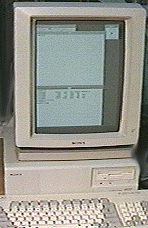
Our original model description (Japanese) The NWS-1450 had a Motorola MC68030 CPU running at 25 MHz, 8 MB of standard memory, and a 240 MB hard disk. Those numbers may look tiny today, but it was a capable workstation for UNIX development and shared use by several people. From then on, I was absorbed in the NEWS in my ham shack every day. Naturally, I connected it to a radio so that friends could use it too. Students from Yamagata University would log in over the air, and before I knew it, another piece of software had appeared. That one machine was becoming a shared laboratory. The radio link ran at 1200 bps. Redrawing a whole screen could be painfully slow, but the vi editor let us work on a text terminal without constantly refreshing everything. Even dividing 1200 by eight gives only 150 bytes per second, before allowing for protocol overhead and retransmissions. For writing programs over such a narrow connection, vi was invaluable. TCP/IP over Radio, UUCP over Wired Links: The Terakoya NetworkLater, through JH1YNW of PRUG, the Packet Radio Users Group, we began receiving email and network news from groups such as ampr.* and fj.*. This was not yet the era of browsing the Web. News articles and messages were passed to the next computer, which would carry them onward. On the wired side we used UUCP, Unix to Unix Copy; on the radio side we used KA9Q's TCP/IP software. UUCP store-and-forward transfers and TCP/IP over radio served different purposes. The NEWS at my home became a place where those systems met. Phil Karn, KA9Q, developed software that could turn a personal computer into a TCP/IP client, server, and router. His own account dates its beginnings to late 1985. Long before networking was a standard feature of ordinary PCs, radio amateurs were building these systems for themselves.[2] We used the Terakoya system to distribute network news over radio. The chronology confirms that a Terakoya network on the 430 MHz band began operating in southern Yamagata Prefecture in 1990, with my home handling wired UUCP and wireless TCP/IP transfers. One Yamagata University student, Mr. Matsui, JG2TST, would come to my house after his laboratory closed, finish his assignments on the NEWS, and email them back to the university. Having that environment outside the university, in a private home, was quite a privilege at the time. The Internet was already developing elsewhere in the world, so rather than saying this happened “before the Internet,” it is more accurate to say before commercial Internet access became widespread in Japan. Commercial IP access services began in Japan around 1993. Being able to experiment before then with carrying IP packets over amateur radio and exchanging news and email was an invaluable experience for me.[3] The NWS-1250 and Ethernet Cables through the HouseIn time, I bought a laptop-style NWS-1250 from JIP in Sendai as well. This model appeared in 1990. I do not remember the precise year I bought mine, but UNIX was no longer confined to a machine on a desk: I could carry a workstation with me. 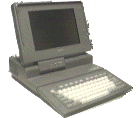
Our original model description (Japanese) It had a 25 MHz MC68030, 4 MB of standard memory, and a 200 MB hard disk. With a monochrome LCD, a weight of about 8 kg, and a 100 V AC supply, it was very different from a modern lightweight laptop. It really was a transportable workstation: you carried it somewhere and plugged it in. Its launch list price was also ¥1,250,000. Yellow Ethernet cable snaked through the house. “Yellow cable” was the familiar name for the thick coaxial cable used by 10BASE5, a very different arrangement from today's patch leads and small switches. The KOA-GIKEN chronology also describes a 1990 gathering at a hot-spring inn where thin 10BASE2 coaxial cable was spread across the tatami mats.[4] Our monthly KOA-GIKEN study meetings in Yonezawa began in 1989. After a meeting, everyone would bring PCs and NEWS machines and become absorbed in talking about UNIX. We hauled those heavy computers around for fun, not for work, and kept talking long into the night. Looking back, what a wonderful way to spend our time. The KISS Interface We Never Got WorkingNot every experiment succeeded. A group of us tried to get the KISS protocol working under NEWS-OS, gathering at my house for several overnight sessions. The relevant code seemed to be there in the kernel sources, yet it simply would not work. This was one challenge we never managed to solve. KISS is a simple protocol for passing packets between a host computer and a TNC. It plays a different role from TCP/IP itself and from AX.25 on the radio link. The 1987 paper by K3MC and KA9Q describes it as a way to make packet handling easier on the host. I can no longer say whether our problem lay in a driver, configuration, or connection details, but the nights we spent puzzling over it are precious memories too.[5] From a Hobby to a Semiconductor Factory SystemI taught myself UNIX and networking on the workstation at home, then applied what I had learned at the company. Techniques I had explored as a hobby became the basis of a quality management system for a semiconductor factory. That work earned me the company president's award from head office. Something I had pursued so enthusiastically in my ham shack had become useful on the factory floor, and the company recognized it. I felt both proud and delighted. I cannot confirm the exact award year from the records at hand, but it remains a defining memory of how my hobby and professional life came together. A Transfer in 1991, and the Launch of Portnet Service in 1995According to the chronology, I moved from the Yonezawa factory back to head office in Noda in 1991. After my transfer, the KOA-GIKEN study meetings moved to Yamagata City. Although I was farther away, the pleasure of UNIX and networking remained central to my life. Alongside the NEWS machines, secondhand Sun workstations began arriving at home, including a Sun 3/80 and SPARC-based systems. Then, in 1995, I installed an analog leased line from Tokyo Internet and obtained an always-on Internet connection at home. Instead of dialing in for each session, our server was permanently connected to the outside world. That was a major change. IIJ began its Internet access service in November 1993, and Tokyo Internet launched its service in April 1995. These dates, which should be distinguished from the companies' founding years, can be confirmed in IIJ's official history and the contemporary Internet White Paper '96.[6] In 1995, the same year Tokyo Internet launched its service, we started our own business, Portnet Service, and began offering Web server hosting.We felt we were working at the forefront of the industry. Under the Portnet Service name, we also sold used workstations and Macintosh computers. I have dated the start of Portnet Service by matching my recollection that we began in the same year as Tokyo Internet's service launch with the documented year of that launch. I have not identified our starting month. The records reviewed here are also insufficient to establish precisely in what sense our service might have been an “industry first,” but this was our venture at a time when the Internet was beginning to reach homes and small businesses. Technical articles still online bear dates in May and June 1996, showing that we were researching and publishing information about repairs and upgrades too. Because we kept trying new things, my then-wife, who was president of the business, was interviewed by various media outlets. UNIX had grown from something I enjoyed with radio friends into work at the company, and then into a business of our own. Perhaps keeping hobbies and work neatly separate was never really possible for me. Those were happy days. I am still grateful to everyone who experimented, thought things through, and stayed up through the night with me. A Timeline of the Memories and Records
This timeline distinguishes personal events from product launch dates. The prices quoted are historical launch prices, not confirmed amounts we paid. I did not find a photograph reliably identified as an NWS-820, so I have not substituted a picture of another model. Contemporary Records and References
| ||||||||||||||||||
| October 20, 2026 October 28, 2026 | ||||||||||||||||||